Thursday, December 19, 2013

Epipremnum Aureum, Pothos - Type of Symptom

Study your Pothos - Understand the Symptom

Plants do not speak of their problem, they show it to you and only those understand it will grow a better plant. There is only a few basic symptom that plants will show.

Symptom of Fertilizer Burn
Brown burnt- looking tips or yellow and brown spots on leaf margins.
This happen when a plant is being given too much fertilizer this is call Fertilizer Burn,
To treat this, reduce the frequency of feeding. if the condition fertilizer burn is bad run the soil with water, this dilute the concentration level in the soil. if it was hydro culture planting, change the water with normal tap water.


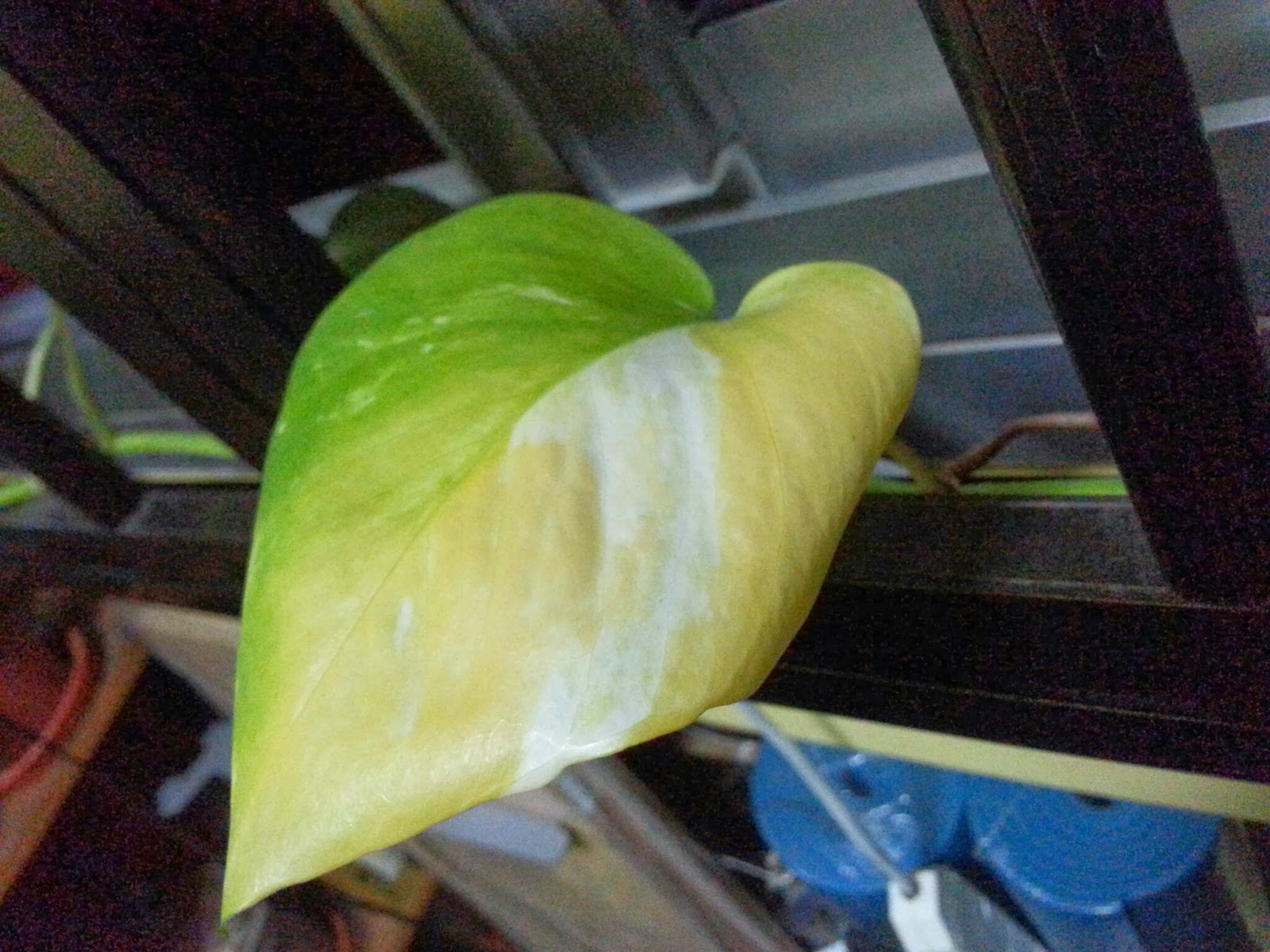
Yellowing of leaves thats cause by Lack of Nitrogen
Yellowing of leaves. Generally this symptom start from older leaves.
this happen when the plants Lacks Nitrogen .


Healthy Pothos with a long inter node

Short inter node that cause by Lack of Phosphorus

New leaves are small, inter nodes are short. comparing the 2 pic above.
This happen when the plants Lacks Phosphorus .


Comparing the vertical vines/ leaves to the Horizontal vines/leaves, same family but at different time
New leaves and stems will get smaller.
This happen when the plants Lacks Pottasium .

Yellowing of leaves between the veins, normally this symptom start from older leaves.
This happen when the plants Lacks Magnesium .

To treat the specific symptom, get a fertilizer with higher number on that specific element. But in general, apply 1 or 2 application of the all purpose fertilizer (NPK15.15.15) should solve all the above issue.

*refer to my other posting on the ways to fertilizes your Pothos.

Epipremnum Aureum, Pothos - With your Fishes Natural Filtration System

Growing Pothos as the tank Natural Filtration System


Continue from the previous experiment to grow Pothos as an aquatic plants.

A fish tank without plants have high nitrate and ammonia from fish waste, so frequent water change is needed. The rate is dependent on the amount of fish in the community. If this routine is not done frequently or at the right time, it will cause damage to the fish organ. In the worst scenario the entire tank will be wiped out. Even the durable sucker fish will not survive.

To balance out this situation, plants is introduce to the tank. Plants help to reduce the toxic level by breaking down fish waste and absorb the nutrient. It forms a cycle that is beneficial to both plant and fish. One of the way to do this is growing Pothos on top of the tank cover with the roots dangling in the water, this add additional toy for the small fish and shrimps. Final step is to attached an artificial light on top for the plant to photosynthesis.

For best result grow your Pothos on the tank top filter. Used the ceramic ring in the filter to provide support for the vines and roots, the water from the tank provide the plant with steady flow of water supply and the water comes with diluted natural fertilizer. When the vine flourish, it will cover up the entire top of your tank and camouflage your filter system. Compare to other aquatic plants Pothos is cheap, durable and easily propagated.

Things to note when you grow Pothos in tanks. With all the supply given, you wont be touching the plant for a long time, over time there will be fallen leaves, these leaves need to be remove as soon as possible, because fallen leaves will rot and cause the water to smell, decomposed material will fight for resources in the tank. so too much of the fallen leaves will spolit the tank eco-system.

Check out my other posting for other interesting things with Pothos.

Wednesday, December 18, 2013

Epipremnum Aureum, Pothos - Fish-less Tank

Growing Pothos in a fish-less tank

Houses in the western country normally comes with a garden of your own. Unlike Singapore houses are small with limited space but there are still many video online showing what they can do living in a small space, so is up to you to explore.

Do not restrict yourself to just 1 or 2 growing method, play around with the tools or item around you and you can amuse yourself with what creativity you can come out with. Pothos is a very strong, durable and easily propagated plant so try all you want with this plant.

growing Pothos in the equipped fish tank

I grow my Pothos in a fish-less tank, equipment require is only a lighting system and a simple filter system. Why this idea come about is because I like soil-less planting, I do not want mosquito to breed, I know Pothos root breath. So a equipped tank meet my requirement. (a small tank are able to support about 6 small Pothos)

Start off use some clothes pin attached it with the Pothos to the side of the tank, this give them the support. Pour in the water and activate the filter pump and attach the lighting, the light does not need to be always on, this greatly depend on your placement of tank. Place the tank near the window for natural light source. If additional light is require you can always add in more lamps.

A good healthy water change frequency is once every 2-3 days, you can change it once a week. Just add in some liquid fertilizer when you do a water change this will boost a lot of growth in the plant and you never have to worry about your plant dying of thirst.

the Pro:
1 - Is soil-less, so it will be clean, more space for the roots to grow.
2 - The water is moving seamlessly, so mosquito wont breed (not 100%, monitoring still require)
3 - In Feng Shui theory, flowing water is a sign of wealth, if place in the correct location it will bring you prosperity.
4 - sound of the water flow create a tranquil environment.
5 - With the water fall filter, this will dissolve oxygen, enable the root to breath (not sure if the root can breath underwater).
6 - does not require to change water that frequent but require to add in water with the fertilizer weekly.

the Con:
1 - require power supply,
2 - require to change to liquid fertilizer.

I had tried this method of fish-less tank growing for months already, most of Pothos flourish in the tank and none of them wilt. They only fight for space be it roots or the leaves and in fact I still have to remove a few of them to make space for the rest.

Check out my other post on Pothos

Tuesday, December 17, 2013

Epipremnum Aureum, Pothos - With your Fishes (experiment)

Growing Pothos with your fishes

Plant have natural ability is to break down fish waste but Pothos is not an aquatic plant. I decide to experiment if Pothos survive under water.

Test Subject: 2 new Pothos cutting, each with 1 leaf insert into a plastic cup, tied with some pebbles to provide weight for it to sink.

Apparatus: 2 lighting blue/white and white were used to brighten up the tank. A water fall type filter and a external breeder tank customize to become a water filter for charcoal and ceramic ring, contain only 2 Yamato Shrimps, 2 Guppies, 1 SAE and 1 Corydoras and 1 Java Fern

Duration: Lasted for 3 week.

Observation: The cutting do not grow in size, some sign of roots growth, some sign of new bud/shoots, no change in vine or leaf color. I assume it can only survive, maybe very slow growth.

To further the experiment I remove the cutting and place it into the external breeder tank, for 1 week the condition of the cutting remain the same.

Next I tried placing the cutting into the external breed tank with only the roots submerge into the water. The area was further away from the light source so i cant really continue to find out more.

Months ago I spoke to a landscape specialist to understand more about plant. He mention during the removal of the plant there is a possibility it will cause the plant to go into shock mode. Shock mode refer to adaptability to a change of environment or damage to the roots system.

There are many factor affecting to this experiment. I decided to eliminate some of those before trying.

Pothos in the tank
Next experiment I will be trying out new cutting with roots and place it inside (see pic above).

Check out my other post for more Pothos information.

Epipremnum Aureum, Pothos - Different types of Planting Method

Epipremnum Aureum, Pothos - Type of Planting Method

The traditional way of planting Pothos is of cause growing it from soil but I like to plants it without soil, so I experiment with various method of a soil-less planting.

Pothos in the vase

1 - My first and foremost experiment which is also the easiest method, growing the Pothos in vase/ container of water, is quite a traditional way similar to displaying a flower in the vase. This method works for Pothos but the downside of this method is the frequent change of water is needed to promote healthy growth. This method is cheap but require a lot of attention. changing 1 vase is fine, imagine you have more then a vase, say 10 vase at different location. it will be very time consuming.

In a humid and hot weather place like Singapore is a good place for the mosquito to breed. If you leave your plants out there too long without changing the water, this will easily attract Aedes mosquito to breed and spread dengue fever, is harmful to yourself, your family and also your neighbors.

Keep the quantity of Pothos low and this traditional vase method works!

2 - The second method that I'm trying out is planting it using crystal gel as the medium. These gel will absorb water and contain it. When placed in to the container/ pot the plant roots will slowly absorb the water in gel and without the presence of water, mosquito won't be able to breed. These gel can be brought at supermarket or florist. These gel need to be prepared before using, to prepare soaked it in water for 2-3 hours then drain off the excess water and the remaining gel is ready for use.

From the result of using the gel, this gel is good for plants that is small and light, in this case is not suitable for house plant Pothos because when the plant is big, long and heavy, the gel wont be able to support the weight and when it get too big it will uproot itself.

As long as you keep the plant small, crystal gel is a good method.

3 - The third method is using a similar product call the Sumi balls. This material that is very versatile, is light, able to provide aeration for the roots and when given depth is strong enough to support the plant.

With the aqua type of planting Pothos, pot used are different from the usual pots. The bottom of the pot cannot have holes and require a stopper to prevent the water from draining off.

To start off, put the Pothos into the pot semi filled with Sumi balls then cover the roots and few segment of the bottom of the plant with Sumi ball to the slightly more then 3/4 of the pot. this way the plant will be well supported. Thereafter filled the pot with 1/2 water full and not over the sumi ball. If water change is required, just remove the stopper to drain of the water. The frequency is 2-3 times a week.

So far this is the most preferred method, its clean, easy, no pest and beautifully enhance the environment.

check out my other posting for interesting experience with Pothos.

Sunday, December 15, 2013

Epipremnum Aureum, Pothos - Fertilizer

Fertilizing

Pothos need nutrients to grow but where do they get all these nutrient? Soil is the answer. To the human eye, soil can be dirty and with many lurking creature in it but that is the place where plant get their nutrient from. There are many nutrient a plant need for growth. Nutrient are classified as  2 main types, Organic and inorganic.

Organic fertilizer come from living things, animal dung, blood, bones, remains of any dead insect etc. All this can be process by manufacturers in pellet or powdered forms.

Inorganic fertilizer are chemicals use commonly by the home gardener. normally refer as NPK fertilizer. N for Nitrogen, P for Phosphorus, K for Potassium. the higher the value beside it the higher the concentration. These are the 3 main element that plant needs for foliage, roots and flowering growth. other then these 3 element plant still need other micro nutrient and we call is Trace elements, inclusive of copper, iron, zinc etc. Below is a photo of the fertilizer packaging i brought from supermarket.

photo of the NPK fertilizer
As for the Pothos case, its better to have a regular supply of fertilizer, always provide your Pothos with small quantity. Read the packaging to direction, if unsure use an amount lesser then the recommended. Try and error for better result.
*Note - Pothos will not have immediate effect when you fertilized. If too much is used, the plant will result in fertilizer burn and lost it rigidity at a very fast rate.

Frequency of applying the fertilizer various. fast growing plant require a closer frequency then slow growing plant. Is recommended to use a dilute fertilizer for weekly application.

photo of the slow releasing fertilizer
Alternatively you can choose this slow releasing fertilizer. Normally comes in tablets or stick forms, placed it at the side of the pot and it can last you for 30 days.

Thursday, December 12, 2013

Epipremnum Aureum, Pothos - Propagating

Understanding your Pothos


We tried planting it and it beautify our house and now we want more of it.

As mention Pothos is a strong and durable plant and some comments from the net is this type of plant can survive better when is left unattended, duration was not specify so i decided to try out. I put my Pothos outside the walkway where they can get their supply from the natural source and the plant really shown strong will to survive. Such a strong plant propagating it will be very easy.

Initially when I started playing with Pothos, I know nuts about it all I know is this plant suitable for newbie. Since I'm new to garden i just start with this. Looking thru the website, YouTube and some random forum, I somehow know how to clone but still is full of doubt so I try it out myself.

Before we propagate it, we need to know some of the basic plant parts before you can properly locate where to cut.

Illustration of Pothos parts
Propagating

when I was researching on the ways and method to clone Pothos, I found 2 version. Refer to the photo above.

I have made indication on the photo the basic component of Pothos part and location to cut. The 2 version found in the net is cutting from point 1 and the other is from point 2. Both method have been explored and experiment and both ways work. Personally I prefer doing it from point 1, this give your new Pothos cutting an allowance between the plant and the base of the pot, more rooms for the root growth. If is place in the vase, the base of cutting is longer to absorb the water, but eventually the vine below the node will wilt depending on the amount of water given.

For new cutting, have at least 2 leaves, but I wouldn't suggest anything more then 3. Reason to be, having more leaves at the new cutting will boost the new house plant evaporation rate. The root system is not establish thus the water intake will be lesser then the water output and this will put risk to the new plant.

Put your new cutting into the vase, normally within a week roots will start to grow from the node or an extension of root from the existing root.

Check out my other post for more Pothos information.